
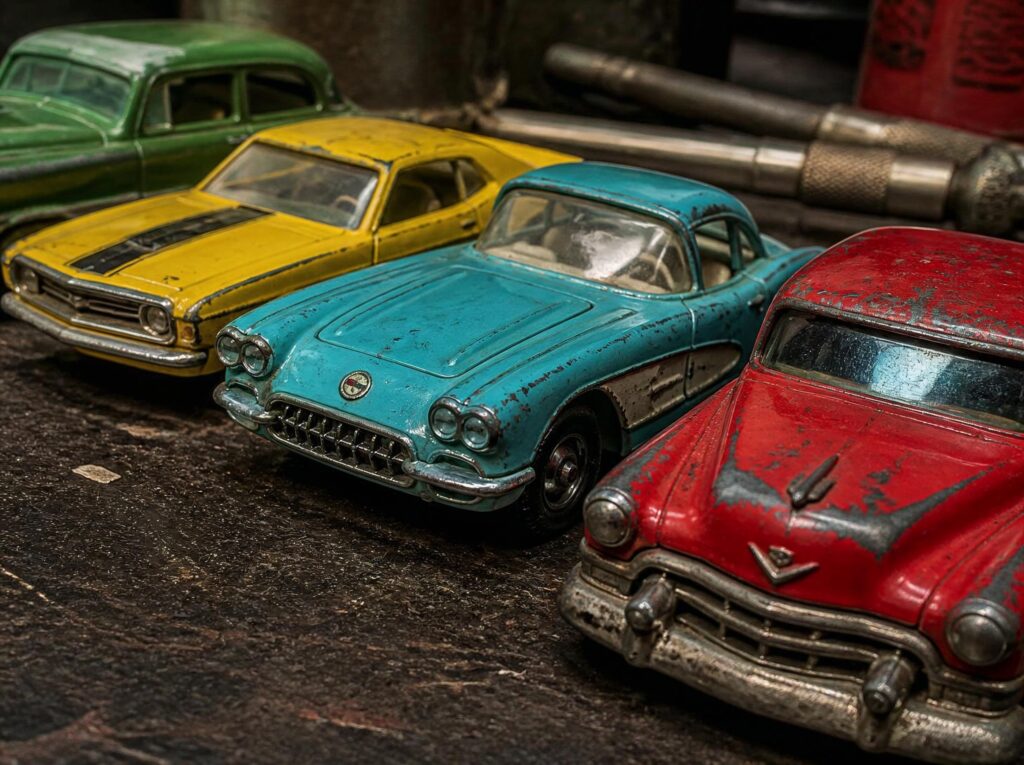
Valuable Die-Cast Cars: Finding Rare Hot Wheels and Matchbox in the Bin.
You are looking at a plastic bucket filled with hundreds of small toy cars at a yard sale. The price tag says five dollars for the whole lot. Most people walk by because they aren’t looking for a “bin of toys” for a kid’s sandbox. In the trade, we know that one single car in that bucket could be worth ten times the price of the entire bin. Finding rare die-cast cars is a high-margin part of the business where a single “Redline” or “Treasure Hunt” can have a value range of $20 to $150 or more. If you know what to look for, a five-minute scan of a junk bin can turn into a significant payday.
The Excuse: “It Is Just a Box of Kids’ Junk”
The biggest excuse I hear about die-cast cars is that you have to be a walking encyclopedia of toy history to find the winners. People think they need to know every model, every paint color, and every year of production. While you are worrying about the “work” of looking at every tiny car, a savvy scrapper is using a “material scan” to pick out the high-value pieces in thirty seconds flat. That is profit being left for the next person because you were overthinking the process. You are letting the volume of the items scare you away from the value.
The solution is to stop looking for specific models and start looking for specific manufacturing “tells.” You do not need to be a collector; you just need to be a scout. Once you understand how the metal behaves and what a “Real Rider” feels like, the bin becomes an inventory list instead of a mess of plastic. This isn’t about playing with toys – it is about identifying industrial assets that have been discarded by people who don’t know the secondary market value of what they hold.
The “Heavy Metal” Scan: How to Sort in Seconds
You do not have to pick up every car one by one and read the bottom. You and me, we use the “Weight and Material” method to filter out the modern plastic junk from the high-density vintage winners. This is how you work through a 200-car bin in under two minutes.
1. Metal on Metal
Pick up a handful of cars. If they feel light, hollow, and make a “clicky” sound when they hit each other, they are modern cars with plastic bases. We are looking for weight. In the early days of the trade, Hot Wheels and Matchbox cars were made with a metal body and a metal base. These are called “Metal/Metal” cars. They have a distinct heft and a cold feel to the touch. A vintage metal-on-metal car from the 1970s or 80s has a value range of $15 to $45 even in “played with” condition because the materials are simply higher quality.
2. The Redline Check (1968 – 1977)
This is the “Holy Grail” for die-cast scrappers. While you are scanning the wheels, look for a thin red circle around the rim of the tire. If you see that red line, you have found a “Redline.” These were the original Hot Wheels produced during the first decade of the company. Even if the paint is chipped, the axles are bent, and the windshield is cracked, an original Redline can have a value range of $30 to $100. If you find one in excellent shape, that price can climb much higher. Never leave a Redline behind, regardless of its condition.
3. “Real Riders” (Rubber Tires)
Modern cars can be valuable too, but you have to look at the rubber. Most toy cars have hard plastic wheels that slide on the floor. We want “Real Riders.” These are cars with actual rubber tires that have visible tread on them. You can feel the difference with your thumb – they have a “grip” to them. If the tires are rubber, the car was part of a “Premium” or “Adult Collector” line. These always sell faster and for more money, usually in the $10 to $25 range.
High-Value Brands Beyond Hot Wheels
While Hot Wheels is the name everyone knows, they aren’t the only metal in the bin. In the business, we look for brands that prioritized “how the metal behaves” over cheap production costs.
- Matchbox (Lesney Era): Look at the bottom of the car. If it says “Made in England by Lesney,” you have a winner. These older Matchbox cars have incredible detail and a very high “metal density.” Their value range for common models is $10 to $30, but rare utility vehicles can go higher.
- Corgi and Dinky: These are usually larger than standard Hot Wheels (1:43 scale). They were made in the UK and are known for their heavy weight and moving parts – like doors that open, hoods that lift, or even working suspension. A solid Corgi car from the 1970s has a value range of $20 to $60.
- Tomica: These are Japanese die-cast cars. They are smaller but very heavy for their size. If you see “Japan” on the base of a small car, put it in your bag. They are highly sought after by international collectors and have a value range of $15 to $50 for vintage models.
The “Treasure Hunt” Secret
In the mid-1990s, Hot Wheels started hiding “Treasure Hunt” cars in regular cases to keep collectors looking. These are rare versions of standard cars that look almost identical to the common ones at a glance. How do you spot them in a junk bin? Look for a small “flame in a circle” logo hidden somewhere on the car’s paint job – usually on the door or the hood. On newer cars, look for a small “TH” printed on the side. If you find a “Super Treasure Hunt,” it will have “Spectraflame” paint – which looks like a deep, metallic candy coating – and rubber tires. A Super Treasure Hunt can have a value range of $40 to $150 depending on the model.
How the Material Behaves: The “Base” Truth
Turn the car over. The base is the “ID card” of the vehicle and tells you everything about its value in the trade. Many cars have a date on the bottom, but be careful – that date is usually the year the “casting” was patented, not the year the car was made. Look for “Hong Kong” or “USA” on the base. These are generally older and more valuable than cars marked “China” or “Malaysia,” which are the modern standard. If you find a car that has no paint – just bare gray metal – or is missing its wheels from the factory, don’t throw it back. “Factory Errors” are a niche market where a “mis-made” car can bring a paycheck of $20 to $50 to a specialized collector.
Did You Know?
The most valuable part of a die-cast car might be the “color” of the glass or the interior. In the 1960s and 70s, some cars were released with “blue tint” or “purple tint” windows instead of the standard clear plastic. But here is the real pro tip: Look at the interior seats. If you find a car where the interior color doesn’t match the standard production – like a white interior in a car that usually has black – you might be holding a rare “transition” piece. Collectors call these “variations,” and a simple color swap on a plastic seat can turn a $2 car into a $40 asset. Always look inside the windows before you decide a car is “common.”
No More Excuses: Small Space, Big Profit
I hear people say they don’t want to deal with small items because they are easy to lose or hard to track. That is the wrong way to look at it. You can fit fifty die-cast cars in a small shoebox. That is fifty potential paychecks taking up less room than one lawn mower in your truck. This is a high-density way to get paid.
When you find a bucket of cars, do not try to research them while standing in someone’s driveway. Buy the bucket, take it home, and dump it out on a clean towel. Use a soft, dry brush to get the dust off. Do not use water if the car has “decals” or stickers, as they will peel right off and kill the value. We want the original finish to stay intact.
Always check your local laws about picking and respect the properties on your route. If you find a bin at the curb, make sure it is actually intended for the trash before you load it. Play it straight, be honest with your buyers about the condition, and your reputation in the business will grow.
I wish you well on your next route. Keep your eyes on the wheels and stay safe.
A Collector’s Resource Hub


Note: Some links may be affiliate resources that support our research.