
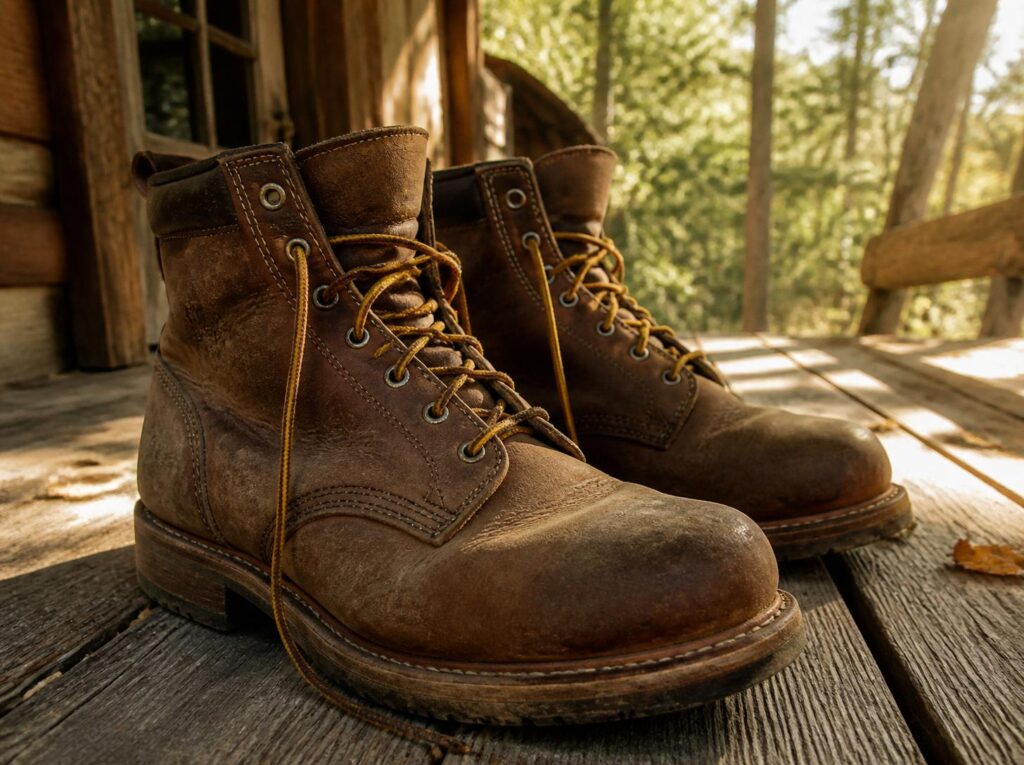
Reselling Leather Boots: How to Clean Up and Flip Old School Footwear.
What’s in the box? While out driving Saturday morning you notice a brown cardboard box sitting at the curb in front of a residence. Someone wrote Free on the outside of the box, so why not stop and take a look. Inside you see 5 pairs of mud-caked boots. They look heavy, they look tired, and most people would think they look gross. Most folks walk off and leave them because they think sorting through old footwear is “unclean” or too much work to restore. They assume that learning how to clean up and flip old leather boots that are scuffed and dirty, is not worth the time and just let them continue their journey to the landfill.
In the trade, we know better. High-quality leather is a biological commodity that behaves a lot like metal – it can be cleaned, polished, and brought back to life. Reselling leather boots is one of the most profitable routes you can take, where a “junk” pair of boots can be turned into a paycheck ranging from $40 to $150 or more. Suddenly learning how to clean up and flip old leather boots doesn’t sound to bad. If you can spot the quality of the hide, you can spot the profit in the dirt.
The “Gross” Excuse is Costing You Money
The biggest excuse I hear about footwear is the “ick factor.” People think they are buying someone else’s problems or that the boots are too far gone to be saved. While you are worrying about whether the boots are “too used,” a savvy scrapper is looking at the thickness of the hide and the brand of the sole. That is profit sitting in the dirt because you are letting your feelings get in the way of the business. Every time you drive past a pair of heavy work boots, you are handing a fifty-dollar bill to the garbage man.
The solution is to stop looking at the dirt and start looking at the construction. Leather is an incredibly durable material. As long as the “bones” of the boot are solid, the surface dirt is just a distraction. Once you understand how to identify a “Goodyear welt” and a high-density leather grain, you will realize that those muddy boots are just a few minutes of cleaning away from being a high-demand asset. In the secondary market, buyers value the “broken-in” feel of quality leather because they know it means the material has already proven its strength.
How to Identify “Forever” Boots: The Material Scan
In this business, we are looking for boots that were built to be repaired, not thrown away. You can tell a quality boot in about thirty seconds by looking at three specific areas. You and me, we use the “Material Scan” to find the winners in the bin.
1. The Goodyear Welt
Turn the boot over and look at the seam where the upper leather meets the rubber or leather sole. If you see a heavy row of stitching running all the way around the edge of the sole, that is a Goodyear welt. This means the sole is stitched to the leather, not just glued on with cheap adhesive. In the trade, this is the mark of a “forever” boot because it can be resoled over and over. A welted boot can have a value range of $60 to $120 even if the leather is scuffed or the sole is worn down.
2. Full-Grain Leather Thickness
Pick up the boot and feel the weight. How the leather behaves when you flex it tells you everything about its density. You want leather that feels thick, supple, and “oily” to the touch. If the leather is paper-thin or starts to peel away in layers like a sticker, it is “bonded leather” or a synthetic imitation. We want the boots that feel like they could stop a shovel. High-density leather from reputable brands has a value range of $75 to $150 because it can be conditioned back to its original state.
3. Hardware and Eyelets
Look at the holes for the laces. We want to see heavy brass, steel, or nickel eyelets and “speed hooks” at the top of the boot. If the hardware is plastic or thin aluminum that is bending out of shape, the manufacturer cut corners on the rest of the boot too. Solid metal hardware is a sign of an industrial-grade garment that was meant for a job site, not a fashion show.
The “Big Three” Brands to Watch For
While there are hundreds of boot makers, these three are the most common winners you will find at garage sales or sitting on the curb. They have high brand recognition and consistent resale value.
- Red Wing: These are the gold standard of American workwear. Look for the “Red Wing” logo stamped into the side of the heel or the white “Irish Setter” tag inside the tongue. Even a pair of Red Wings that look like they have been through a war can sell for $50 to $100 for parts or restoration projects.
- Dr. Martens: Look for the signature yellow stitching around the sole and the “AirWair” pull tab on the heel. If it says “Made in England” on the sole, you have found a major payday. The older English-made versions have a value range of $80 to $200. The modern versions are still a solid, fast flip in the $40 to $70 range.
- Timberland (The “Yellow Boot”): These are common, but you have to check the waterproof seal and the nubuck leather. If the leather is still supple and the “tree” logo is clearly visible on the heel, they move very fast in the secondary market. A clean pair of classic Timbs has a value range of $50 to $90.
Turning “Trash” into “Old School” Cool
You do not need to be a professional cobbler to make a boot look good. You just need to remove the “curbside” look and restore the natural oils to the material. Leather is skin; it needs moisture to stay strong. Start by taking the laces out and throwing them away – a new pair of laces costs three dollars and instantly makes a boot look five years younger. Use a stiff brush to get the loose mud and dust off the surface.
Then, use “Saddle Soap” and a damp rag to clean the leather. Do not soak the boots; just work the soap into a lather and wipe it away. Once they are dry, apply a coat of leather conditioner or “Mink Oil.” You will see the leather drink it up and the deep, rich color will return. You are not “fixing” the boot; you are just hydrating the material. A clean, conditioned boot is an asset that buyers can trust.
Did You Know?
The most valuable part of a boot might be a small tag you can’t see from the street. Look inside the tongue or along the inner ankle for a “union stamp.” It is usually a small white tag with a blue or red logo indicating it was made by organized labor. In the business, “Union Made” boots are highly prized because they were built to higher labor and material standards than mass-produced imports. But here is the real pro tip: check the sole for the “Vibram” logo – a small yellow octagon. Vibram is the world leader in high-friction, durable soles. A boot with a Vibram sole and a Union Made tag is a “triple threat” that can easily fetch the top end of your value range, sometimes reaching $150 to $250 for rare vintage work models.
No More Excuses: Scaling the Footwear Route
I hear people say they don’t have the space to store shoes or that they don’t want to deal with different sizes. A pair of boots takes up less room than a toaster. You can store a dozen pairs in a single plastic bin. It is a high-density, high-margin part of the trade that requires very little overhead. As for the sizes, there is a buyer for every size, from the small 7s to the giant 14s. In fact, the very large and very small sizes often sell for more because they are harder to find in retail stores. You are providing the inventory that the big malls don’t carry.
When you find boots, don’t worry about the “broken” look. Collectors of vintage workwear actually prefer a bit of patina – that natural wear that only comes from years of use. It proves the leather is authentic. Always check your local laws about picking and be respectful of the properties on your route. If you find a pair at the curb, make sure they are actually intended for the trash. If they are in a box with other “free” items, get them in the truck before the rain hits.
I wish you well on your next route. Keep your eyes on the stitching and stay safe.
A Collector’s Resource Hub





Note: Some links may be affiliate resources that support our research.