
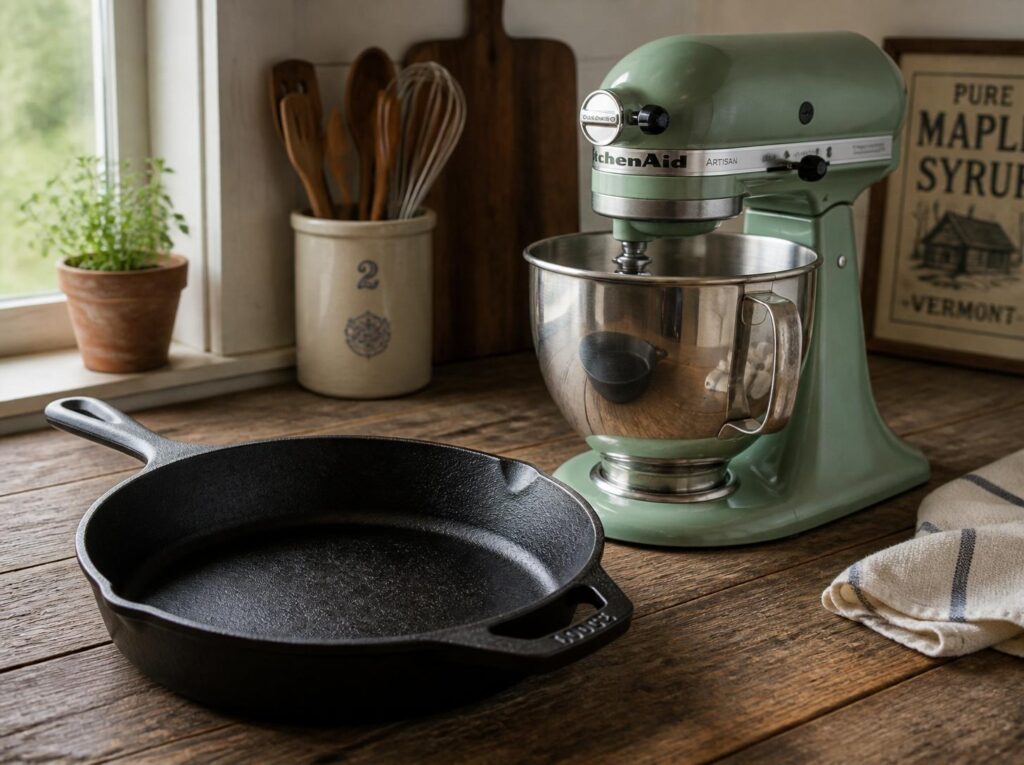
Selling Vintage Kitchenware: Why Cast Iron and Mixers Still Make Money.
You are looking at a heavy, black frying pan sitting in a cardboard box at a garage sale. It is covered in a layer of rust and looks like it was used to catch oil in a garage. Most people walk past it because they don’t know it’s vintage kitchenware that sells well. They just think it is “dirty” or “ruined.” They think a pan that isn’t shiny and non-stick belongs in the scrap heap. In the trade, we know what vintage kitchenware that sells well, especially a pan made of heavy black metal is a “forever” asset.
Selling vintage kitchenware, specifically cast iron and stand mixers, is one of the most reliable ways to get paid because these items were built with industrial-grade materials that are hard to wear out. A rusty skillet found for a dollar can be a paycheck ranging from $30 to $150, and a dusty mixer can bring in $50 to $200 or more. These are pieces of engineering that were built to last a lifetime, and the secondary market is always hungry for them.
The Myth of the “Ruined” Kitchen Tool
The biggest excuse I hear about vintage kitchenware is that it is too hard to clean or that it is unhygienic once it shows rust. People see a bit of surface oxidation on cast iron or a seized motor in a mixer and assume the item is dead. While you are worrying about the “work” of scrubbing or the weight of the machine, a savvy scrapper is looking at the manufacturer’s mark on the bottom of the pan or the serial plate on the mixer. That is money being left on the table because you are looking at the surface dirt instead of the quality of the casting. You are letting a little bit of grime stand between you and a significant profit.
The solution is to understand how the metal behaves. High-quality cast iron is virtually indestructible under normal conditions. As long as it isn’t cracked or warped, it can be restored to a “like-new” state with very little effort. Similarly, vintage mixers were built with all-metal gears that are designed to be serviced and greased, not thrown away like the plastic junk you find at big-box stores today. Once you realize that “old” often means “better-made,” you will stop seeing junk and start seeing inventory. You aren’t just selling a pan; you are selling a tool that will outlive the person who buys it.
Identifying High-Value Cast Iron: The “Bottom” Scan
In the secondary market, the value of cast iron is all about the “pour” and the finish. Older pans were cast in fine sand molds and then the cooking surfaces were ground smooth by hand or machine. You can tell the difference in seconds with a simple physical check. You and me, we don’t buy the “bumpy” stuff.
1. The Smoothness Test
Run your finger across the cooking surface inside the pan. If it feels like a piece of polished glass, it is a vintage piece. Modern, cheap cast iron feels like sandpaper because the manufacturers skip the grinding step to save money. Collectors want that smooth surface because it becomes naturally non-stick when seasoned correctly. A smooth-bottomed vintage pan has a value range of $40 to $120 depending on the size and the maker.
2. The Manufacturer’s Marks
Turn the pan over. We are looking for names like “Griswold” or “Wagner Ware.” A Griswold pan with the “large logo” – which is a cross inside a circle – is a major find. Even if it is covered in three decades of crusty old grease, it has a value range of $60 to $150. Also, look for the “Heat Ring” – a thin ridge of metal running around the outer edge of the bottom. This is a sign of an older, more collectible piece from the early 20th century. If you see “Made in USA” on the bottom, it usually dates the piece to the 1960s or later, which is still good, but the older unmarked pieces can be even more valuable.
3. The “Ring” Test
Hold the pan by the handle with one finger and tap the side of the rim with a wooden spoon or your knuckle. It should ring with a clear, bell-like tone. If it makes a dull, flat “thud,” there is a hidden hairline crack in the metal. A cracked pan is only worth its weight in scrap metal, as the crack will expand when heated. But a ringing pan is a piece of history that is structurally sound and will sell fast.
The “Heavyweight” Winner: Vintage Stand Mixers
When you find a stand mixer – like a KitchenAid or a Hobart – you are looking at a piece of industrial machinery shrunk down for the home. These are the workhorses of the trade and they rarely fail completely.
- KitchenAid (The Solid State Rule): Look for the older models made in the USA. These are heavy because the internal gears are made of hardened steel or brass, not the nylon or plastic found in modern versions. If you turn it on and it groans or leaks a bit of oil, it likely just needs the old grease swapped out. A vintage KitchenAid found at a yard sale or in a “free” box has a value range of $75 to $150 even if the paint is chipped.
- Hobart-Era Machines: If you see the name “Hobart” on a KitchenAid mixer’s trim band or base, you have hit the jackpot. These were the commercial-grade machines built before the brand was sold to a larger corporation. They are heavier, more powerful, and virtually bulletproof. Their value range is often $150 to $300 because professional bakers hunt for them.
- The “Orphaned” Attachments: Never leave the silver bowls, the wire beaters, or the dough hooks behind. In the business, we call these orphaned parts. A single original stainless steel bowl can have a value range of $20 to $40 on its own. If you find a box of “kitchen junk” with these parts, grab them even if the mixer isn’t there.
How the Metal Behaves: Dealing with Rust
The biggest hurdle for most people is the rust on cast iron. Do not let it scare you. Rust is just a surface oxidation; it hasn’t changed the integrity of the iron itself. You can remove rust with a simple soak in a 50/50 mix of white vinegar and water for a few hours. Use a steel wool pad to scrub away the loosened rust, then rinse and dry it immediately. Once the rust is gone, you “season” the pan by coating it in a thin layer of grapeseed or flaxseed oil and baking it in an oven at 450 degrees for an hour. You are not “repairing” the metal; you are just sealing it from the air. This simple process can turn a $2 yard sale find into a $75 professional tool that is ready for the kitchen.
Did You Know?
The most valuable part of a cast iron find might be a “ghost mark.” In the early 20th century, foundries would sometimes buy molds from competing companies and grind off the old name before casting their own. However, you can often still see a faint “ghost” of the original logo underneath the new finish. But here is the real pro tip: check the handle for a “letter” or a small geometric shape. A stylized number like “7” or “8” is standard for the size, but if you find a pan with a small, raised “spider” logo or an odd shape on the underside of the handle, you might have found a “Wapak” or another rare “fantasy” piece from a prestigious foundry. These rare variations can double your payday because collectors love the mystery of an unmarked winner that shows its pedigree in the casting.
No More Excuses: Heavy Metal is Easy Money
I hear folks say they don’t want to carry heavy pans around or that they take up too much room. That is the wrong way to look at it. One cast iron skillet takes up almost no room in your truck, it can’t be crushed by other items, and it will never break if you drop it. It is the perfect inventory. It is durable, high-density, and holds its value regardless of market trends.
You do not need to be a chef to sell kitchenware. You are an industrial scout. You are looking for high-density iron and high-torque motors. When you find these items, you are saving a piece of manufacturing history from the scrap heap and putting it back into a kitchen where it belongs. You are doing the world a favor while getting paid.
Always check your local laws about picking and be respectful of the properties on your route. If you find a pan at the curb, make sure it is actually meant for the trash and not just left out by mistake. If it is in a “free” box, get it in the truck before the morning dew starts to rust it further. Play it straight, be honest with your buyers about any minor pits in the metal, and stay safe.
I wish you well on your next route. Watch your toes when you are moving that heavy iron and stay safe.
A Collector’s Resource Hub





Note: Some links may be affiliate resources that support our research.