
Vintage Denim and Workwear: How to Spot Profitable Jeans and Jackets.
Finding old vintage denim and workwear is likely going to take a bit more work but the values they can be resold for, make up for it. People do throw out tons of old jeans everyday but since they are likely inside of closed trash bags, we’ll talk about value and identifying marks you need to look for. Many people don’t think about reselling their old jeans or finding old workwear to sell. Old jeans are thrown out or kept as fitness goals. Old workwear is nearly always converted to working in the yard or garage wear but it is thrown into the trash or donated everyday as well.
Most people avoid this type of opportunity because they think sorting through old clothes is “dirty work” or “too much trouble.” They assume that if it isn’t brand new with tags, it has no value. In the trade, we know that the “dirtier” and more worn a piece of workwear is, the higher the payday can be. Selling vintage denim and workwear is a specialized part of the business where a single jacket found in a “free” box can bring a paycheck ranging from $50 to $400. High-quality denim is more than just clothing; it is a durable commodity that holds its value for decades.
The Myth of the “Old Clothes” Excuse
The biggest excuse I hear in this business is that clothes are too hard to sort. People think they need to be a fashion expert to find the winners. They think they have to know every brand and every year. That is not how we do things. You do not need to be a designer; you just need to know how the material behaves. When you learn to spot the density of the fabric and the age of the hardware, the “work” of sorting becomes a quick, profitable scan.
While you are worrying about the “work” of sorting through a bag of laundry, a professional is pulling out a pair of 1980s jeans that will pay his rent for the month. That is money being thrown into a landfill because someone was afraid to get their hands dusty. The solution is to look for the “industrial” signs of quality: the weight of the fabric, the type of stitching, and the specific labels that tell a story of American labor. In the secondary market, “wear and tear” is often rebranded as “authentic character,” and people will pay a premium for it.
Identifying High-Value Denim: The Levi’s “Tells”
When it comes to the secondary market for denim, Levi’s is the undisputed king. However, you need to know which ones are “commodities” and which ones are just “mall clothes” produced in the millions. You and me, we are looking for the pieces that were built before the manufacturing processes were thinned out for mass consumption.
1. The Red Tab and the “Big E”
Look at the small red ribbon on the back pocket. If the “E” in “Levi’s” is a capital letter, you have found a “Big E” piece, usually from before 1971. Even though our focus is often on the 1985-to-present era, these older pieces still show up in estate cleanouts and curbside bags more often than you’d think. A “Big E” jacket or pair of jeans can have a value range of $200 to $800 depending on the condition. It is the gold standard of the trade.
2. The Redline Selvedge
Turn the leg of the jeans inside out at the bottom hem and look at the inner seam. If you see a white strip with a red thread running through it, that is “selvedge” denim. This means the fabric was made on an old-school shuttle loom rather than a modern projectile loom. Collectors go crazy for this because it represents a higher density of weave. Even a pair of 1980s “Redline” 501s can fetch a range of $150 to $350 in the secondary market.
3. The Care Label and “Made in USA”
If the jeans were made after 1985, look at the internal care label. If it says “Made in USA,” you have a winner. In the early 2000s, most production for major brands moved overseas to cut costs. Collectors and blue-collar workers alike want the American-made stuff because the denim is heavier and the stitching is reinforced. These standard 90s jeans have a value range of $40 to $85 and move very quickly.
The Workwear Goldmine: Carhartt and Beyond
In the trade, “workwear” means clothes that were built to survive a construction site or a factory floor. Right now, the secondary market is obsessed with “faded” and “distressed” work clothes. The more evidence of hard work on the fabric, the better.
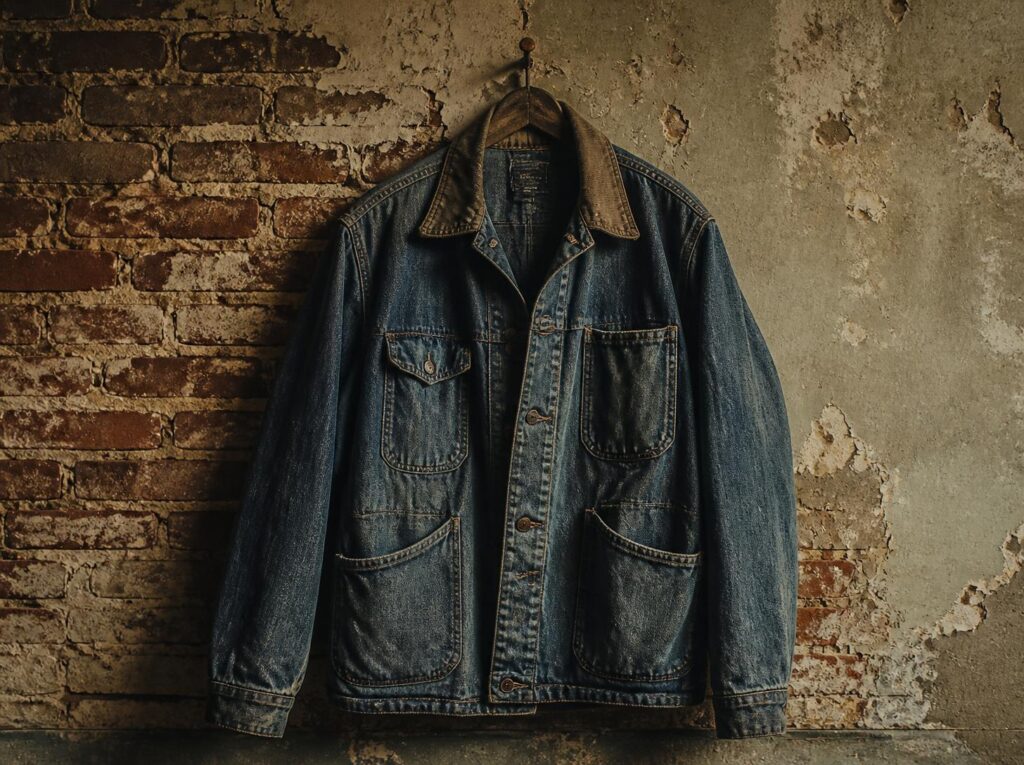
- Carhartt Jackets: Look for the “Detroit” jacket – these are the short ones that hit at the waist and usually feature a corduroy collar. If the jacket is faded, has paint splatters, or has a bit of fraying at the cuffs, do not leave it. A “beat-up” vintage Carhartt jacket can actually sell for more than a brand-new one, often in the range of $75 to $200.
- The Union Label: Look inside the pockets or behind the main neck tag for a small, white or blue “Union Made” stamp. This is the mark of high-quality industrial manufacturing. It tells the buyer that the garment was built to the highest standards of the time, often with double or triple-stitched seams.
- Wrangler and Lee: Don’t ignore these. Look for “cross-hatch” denim or “roughout” jackets. A vintage Lee “Storm Rider” jacket with the original blanket lining has a solid value range of $60 to $150.
How the Material Behaves: The “Weight” Test
You can tell quality denim by the weight before you even look at the tag. Modern, cheap denim is thin and has a “stretchy” feel because it is mixed with synthetic fibers like spandex. We want 100% cotton, and we want it heavy. In the business, we look for “12-ounce” or “14-ounce” denim. It should feel stiff, almost like a piece of thin sheet metal. If the jeans can almost “stand up” on their own when folded, you have found a high-density material that will sell fast to someone who wants clothes that actually last.
Did You Know?
The most valuable part of an old work jacket might be the “ghost” of a patch. If you find a jacket where a company logo or a name tag was clearly removed, leaving a dark spot where the original color remains, do not think it is ruined. Collectors call this “character” and it proves the age of the garment. But here is the real secret: check the “rivets” – those little metal studs at the corners of the pockets. If the rivets are made of unbranded copper or have a “scalloped” edge, you are looking at a piece of industrial clothing that is likely much older and more valuable than the person throwing it away realized. Those rivets are designed to prevent the fabric from tearing under the stress of heavy tools, and their construction is a direct map to the item’s age.
No More Excuses: Sorting is Scaling
I hear people say they don’t want to bring “dirty” clothes into their house. You don’t have to. You can sort your finds in the garage or the yard. A quick shake to get the dust off and a look at the tags is all it takes to identify an asset. You are not a laundry service; you are an industrial scout. Every bag you ignore is a potential $100 bill sitting in the rain.
When you find a piece that is truly filthy, do not use harsh bleaches or modern “brightening” chemicals. Wash it on a cold, gentle cycle and let it air dry. High heat in a dryer is the enemy of vintage fibers; it can shrink the cotton and ruin the “fade” that collectors are looking for. We want the clothes to stay exactly how the previous owner used them – with the story of their work still visible in the fabric. This is how you preserve the value for the secondary market.
Always check your local laws about picking items from the curb. Be respectful of the neighborhoods you frequent. If you find a bag of clothes, take the whole bag and sort it later so you don’t leave a mess on someone’s lawn. Integrity is the foundation of the trade. If you treat the business with respect, it will treat your wallet with respect.
I wish you well on your next route. Keep your eyes on the labels and stay safe.
A Collector’s Resource Hub





Note: Some links may be affiliate resources that support our research.