
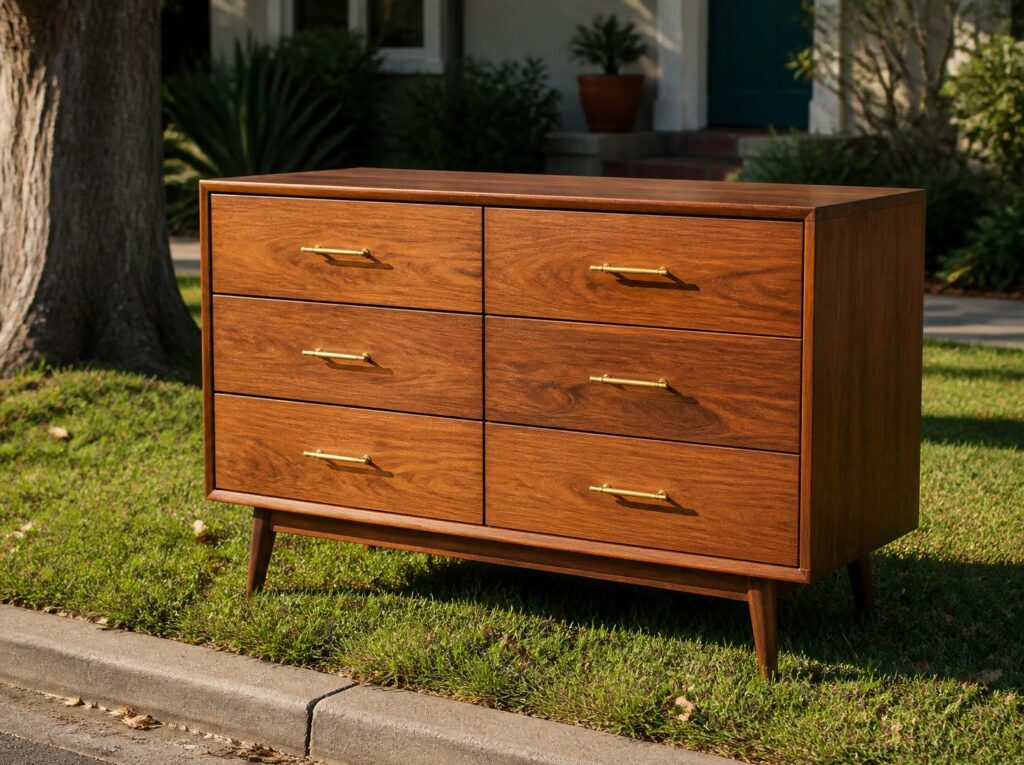
Identifying Solid Wood Dressers: How to Spot Quality Furniture at the Curb.
While driving through a neighborhood on trash day you see a large chest of drawers sitting on the parkway. It looks a bit dull, maybe a little dusty, but the bones look straight. Most people drive right past it because they think it is just “heavy trash.” They assume it is made of cheap, pressed sawdust and glue that will fall apart the moment they touch it. In the trade, we know that a single solid wood dresser can be a payday ranging from $50 to $350 or more, even before a full restoration. The trick is knowing how to tell the difference between a “disposable” piece and a “legacy” piece in under thirty seconds. Identifying quality furniture at the curb is about looking past the surface and seeing the raw material value underneath.
The Real Cost of Driving Past Quality
While you are worrying about whether the piece will fit in your vehicle or if it is too heavy to move, the garbage truck is three blocks away ready to crush a hundred years of craftsmanship into splinters. That is real money being left for the landfill. People make excuses about not being furniture experts, but you do not need a degree to recognize quality. You just need to know where the manufacturer hid the evidence of real labor. The secondary market is always hungry for solid wood because they know modern “flat-pack” furniture simply doesn’t last. The solution is a simple physical inspection that separates the high-value lumber from the particle board junk.
The Three-Point Inspection: Wood vs. Particle Board
When you pull up to a piece of furniture, you are looking for construction, not just color. Do not let a “pretty” finish fool you, and do not let a “scratched” finish scare you off. In fact, a scratched finish is often your best friend because it reveals what is actually under the paint. Look at these three spots to determine how the wood behaves:
1. The Drawer Joints
Pull a drawer out all the way. Look at the front corners where the drawer face meets the side board. If you see “dovetail” joints – those interlocking wedge shapes that look like fingers – you are looking at solid construction. If the drawer is just stapled, nailed, or glued together at a simple 90-degree angle, it is likely cheap modern furniture. Dovetails are a hallmark of the trade that signify a piece was built to last for generations. A dresser with dovetailed drawers can easily have a value range of $75 to $200 in “as-is” condition because it proves the piece is solid wood.
2. The Back Panel and Bottoms
Walk around to the back of the unit. A solid wood piece will usually have a back panel made of thin plywood or even solid wood slats screwed or nailed into the main frame. If the back looks like a giant sheet of thick, fuzzy cardboard or “MDF” (Medium Density Fiberboard), it is a sign to leave it. Check the bottom of the drawers too. We want to see real wood grain or high-quality plywood, not a plastic-coated sheet of pressed wood that bows under the weight of a few shirts.
3. The Grain and Edges
Look closely at the top surface of the dresser. Look for a “repeat” in the wood pattern. Real wood never repeats perfectly because no two trees are exactly the same. If the pattern looks like a photograph printed over and over again, it is a laminate sticker. Look at the edges of the top – if you see a thin “seam” where a sticker is peeling off to reveal gray, crumbly sawdust underneath, that is particle board. We want to see solid end-grain or a thick wood veneer over a solid lumber core.
Identifying High-Value Wood Species
Knowing what kind of wood you are looking at helps you set your price range when you get it back to the yard. Different woods require different care, but they also command different paydays in the secondary market.
- Oak: Very common in the 1980s and 90s. It has a very “open” and deep grain you can feel with your fingernail. It is heavy, durable, and always in demand for its strength. Oak has a distinctive “cathedral” grain pattern that is easy to spot from the street.
- Maple: This wood is incredibly heavy and feels very smooth. The grain is “closed,” meaning it feels almost like glass to the touch. It is often used in mid-century modern pieces or high-end colonial reproductions.
- Walnut: This is the gold standard. It is a dark, rich wood that often has a “wavy” or “curly” grain. If you find a walnut dresser, even with some scratches, your value range can jump from $150 to $500 depending on the style. Walnut is the king of the secondary furniture market.
- Pine: Lighter in weight and much softer. You will see knots in the wood. It is a “utility” wood – good for a quick flip, but it usually doesn’t bring the high dollars of the hardwoods because it dings and scratches easily.
The “Mid-Century Modern” Bonus
Keep a sharp eye out for furniture with “tapered” legs – legs that start thick at the top and get skinny as they reach the floor. This style, common from the 1950s and 60s, is highly collectible right now. Brands like Bassett, Lane, or Dixie are the ones we want to see. Even if the top has a water ring or the finish is flaking, a mid-century dresser is an easy sell. Collectors are often looking for these specific “bones” to refinish themselves, meaning you can get paid just for being the one to find it and save it from the dump.
Checking for Structural Integrity
Before you haul a heavy piece into your truck, give it a quick “wiggle test.” Put your hand on the top and try to rock it from side to side. If the frame is “racked” or leaning heavily, it might have internal damage. However, most solid wood pieces can be tightened up with a few screws. The only thing you really want to avoid is “swollen” wood. If the dresser has been sitting in a puddle and the bottom three inches of the wood look like they have expanded or “puffed up,” the wood fibers are ruined. That is one of the few times I will tell you to leave a solid wood piece behind.
Did You Know?
There is a “secret signature” on the back of many high-end dressers that most people miss. Look for a stenciled number or a manufacturer’s stamp on the back panel or even on the underside of the dresser. But here is the real pro tip: check the side of the drawers for a “brand.” High-end companies like Drexel, Ethan Allen, or Pennsylvania House often “branded” or burned their logo into the wood inside the drawer or on the drawer side. If you find a branded name, your resale value instantly goes up because you can prove the pedigree of the piece to a buyer. A branded piece of furniture is a certified asset in the business.
No More Excuses: Get It in the Truck
The biggest excuse I hear is “I don’t have a big truck.” You do not always need one. Many vintage dressers are actually “modular” or the drawers can be removed to make the frame light enough for one person to slide into a van or even the back of a large SUV. If you find a quality piece, do not let it sit. If you have to, pull the drawers out and put them in your backseat, then come back for the frame. Don’t give the next guy the chance to take your profit.
Clean the piece with a little bit of oil soap and a damp rag to remove the “curbside” look. Do not use heavy waxes or “cover-up” markers until you are ready to sell. Most buyers want to see the honest condition of the wood so they can decide if they want to paint it or keep the natural grain. You are providing the material; let them provide the labor if they want a specific look.
Always respect the property and follow your local laws about curbside picking. If you see a “Free” sign, the contract is signed – get that wood in the truck before the garbage man gets there. Play it straight, work smart, and keep your eyes on the grain.
I wish you well on your next route. Watch your back when you are lifting and stay safe.
A Collector’s Resource Hub






Note: Some links may be affiliate resources that support our research.