
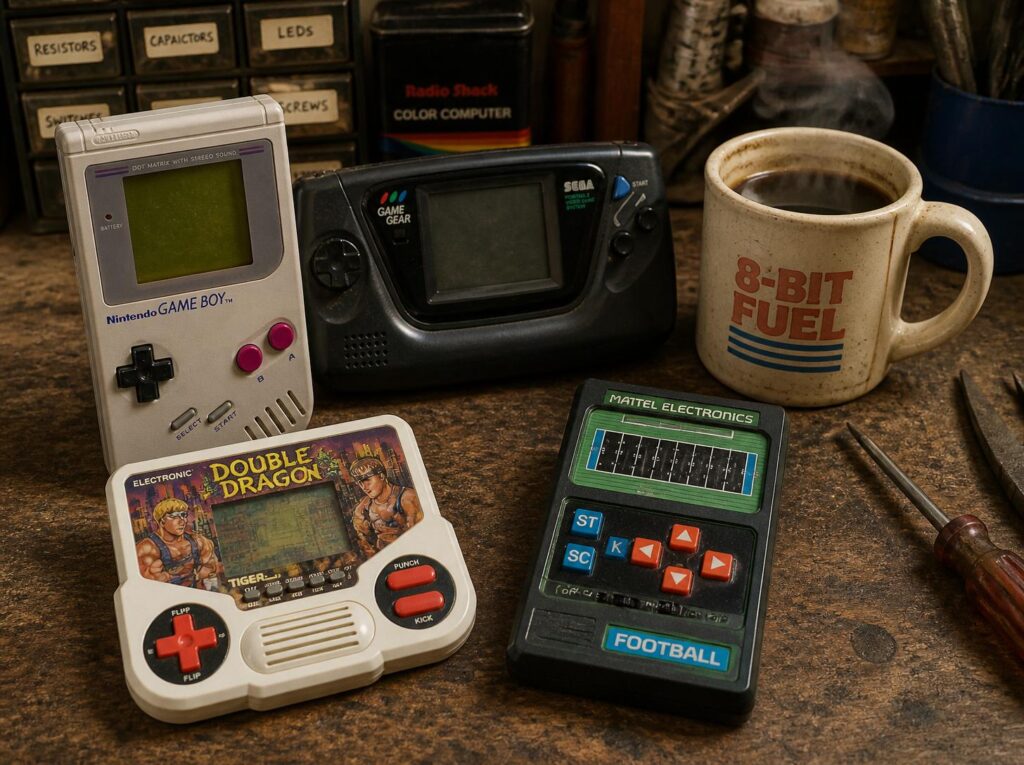
Vintage Handheld Games: Turning Old Nintendo and Sega Systems into Cash.
You are standing in front of a plastic bin at a garage sale. It is filled with old TV remotes, tangled charging cables, and those little flip phones from fifteen years ago. But tucked in the corner is a small, gray plastic brick with a green-tinted screen. Most people see an “obsolete” piece of electronics that probably doesn’t even turn on. They think it belongs in a recycling center. In the trade, we know that gray brick is a high-demand asset. Selling vintage handheld games is a fast way to turn a $2 find into a paycheck ranging from $40 to $120 or more. The demand for these devices has never been higher, as the generation that grew up with them is now looking to buy back their childhood.
The Excuse: “It’s Probably Broken”
The biggest excuse I hear about old electronics is that they are “junk” if they don’t power up. People assume that if a handheld game from 1989 doesn’t have a modern backlit screen or a rechargeable battery, nobody wants it. While you are worrying about whether the device works or if it is “too old” to be useful, a collector is scouring the internet looking for that exact model to repair or display. That is money being left on the table because you are looking for “function” instead of “collectability.”
The solution is to stop treating tech like a tool and start treating it like a commodity. Even a non-working handheld has a value range of $20 to $40 just for the shell, buttons, and internal motherboards. Collectors buy these to perform “transplants” or to practice their soldering skills. If you find one, you put it in the truck. You can worry about the batteries when you get back to the workbench. Every dead unit is a potential donor for a working one, and in the secondary market, that is exactly how parts are valued.
The Heavy Hitters: Nintendo and Sega
When you are out on a route, your eyes should be scanning for a few specific shapes. The secondary market for handhelds is dominated by two names from the 80s and 90s, though a few other players occasionally show up in the bins.
- The Nintendo Game Boy (DMG-01): This is the original “brick.” It is thick, gray, and has signature purple buttons. If you find one of these in decent shape, you have a solid asset. Even without games, these have a value range of $50 to $90. If it is one of the “Play It Loud” versions – which came in colors like transparent, red, or green – the price can jump significantly.
- The Nintendo Game Boy Color and Advance: These are smaller and come in a rainbow of translucent plastics. The Game Boy Advance (the wide one) and the Advance SP (the one that folds in half) are incredibly popular right now. Because they can play older games, they are always in demand. An SP model can fetch a range of $60 to $110 depending on the screen quality.
- The Sega Game Gear: This was Nintendo’s biggest rival in the 90s. It is a large, black handheld that takes six AA batteries. These are famous for having “bad capacitors,” meaning the sound or the screen might be dim. Do not let that stop you. Because they are harder to find than Game Boys, a non-working Game Gear still has a value range of $25 to $50.
How the Material Behaves: Spotting Value in Seconds
You do not need to carry a pocket full of batteries to test every find on the street. You can tell a lot about the value just by observing how the material behaves under physical inspection. We are looking for the integrity of the plastic and the state of the internal components.
1. The Button “Click”
Press the D-pad and the A/B buttons. They should feel snappy and offer a bit of resistance, not feel mushy or stuck. Mushy buttons mean the internal rubber conductive pads are rotted, torn, or coated in decades of soda spills. This doesn’t kill the value, but it tells you if you’re looking at a “parts” unit or a “refurbish” candidate. Original, snappy buttons are a sign of a well-kept device.
2. The Battery Compartment
This is the most important check you can perform. Pop the back cover off. If you see white, crusty powder on the metal springs, that is battery corrosion. It looks like the unit is ruined, but it is actually a “secret” for getting items cheap. Most people think corrosion means the unit is dead. You and me, we know that a little bit of white vinegar and a cotton swab can often clean that right up and restore the connection. A corroded unit you get for $1 can easily be a $50 unit after ten minutes of cleaning.
3. LCD Screen Integrity
Look at the screen while it is off at an angle. If you see a dark “bruise” or a black, oily circle in the middle of the screen, that is called “screen rot” or “vinegar syndrome.” It happens when the liquid crystal or the polarizing film breaks down. While this is a common issue with 30-year-old tech, it does drop the value. However, the internal motherboard is still a valuable asset, so do not leave it behind if the price is right.
The “Tiger” Trap
You will often see smaller, thinner handhelds that only play one game – like “Electronic Baseball” or “Street Fighter II.” These are usually made by Tiger Electronics or Konami. Most of these are not worth much, usually in the $5 to $15 range. However, if you find Tiger games based on popular movies or rare brands, they can surprise you. Don’t spend a lot of money on them at a garage sale, but if they are in a “free” box or cost a dollar, they are worth a spot in your bag. They take up very little space in the truck and add up over time.
Don’t Forget the Cartridges
If you find the handheld, the games are usually nearby in the same bin. Never leave a loose cartridge behind. A single Pokémon or Zelda game cartridge can have a value range of $40 to $100 just on its own. Look for the “Nintendo Seal of Quality” on the label. Even if the label is torn, faded, or has a kid’s name written on it in permanent marker, the chip inside is what matters to the buyer. In the secondary market, “ugly” games still play just as well as “mint” ones.
Did You Know?
There is a “hidden” value in the battery covers of these old handhelds that most people overlook. Because these units were often owned by children, the battery covers were the first thing to get lost or broken. A genuine, original battery cover for a Game Boy or a Game Gear can sell for a range of $10 to $20 all by itself. If you see a bin of “junk” and spot a small piece of gray or black plastic with a latch on it, pick it up. It might look like a piece of a broken remote, but to a collector who is missing that piece to complete their unit, it is the most valuable part of the machine. Always check the bottom of the bin for these “orphaned” plastic doors.
No More Excuses: Tech is Just Another Material
The tech world moves fast, but nostalgia moves faster. Stop making excuses about not being a “computer person.” You are a professional in the trade. You are looking for high-density plastic, copper circuits, and branded logos. When you see that gray plastic, you should see a paycheck.
Clean your finds with a lightly damp cloth and a soft toothbrush for the crevices. If there is sticky residue from an old price tag, use a tiny bit of rubbing alcohol on a cloth, but be careful – too much can cloud the old plastic. Your goal is to make it look like it just came out of a drawer, not a dumpster.
Always check your local laws about picking electronics from the curb, as some areas have specific “e-waste” regulations. But remember, you aren’t “dumping” anything; you are “upcycling” history and keeping valuable materials out of the landfill. You are doing the environment a favor while getting paid.
I wish you well on your next route. Keep your eyes on the bins and stay safe.
A Collector’s Resource Hub


Note: Some links may be affiliate resources that support our research.