
Selling Used LEGO: Why You Never Pass Up a Bag of Plastic Bricks.
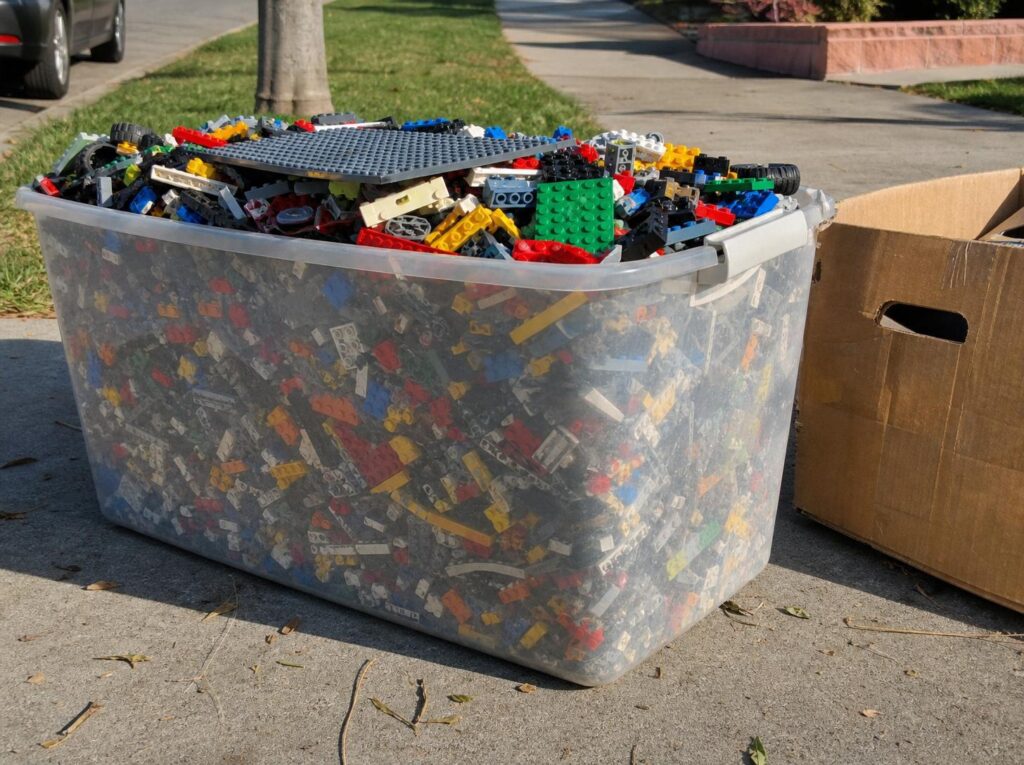
You are driving down a side street and see a heavy kitchen trash bag sitting by a bin. It is lumpy and makes a distinct, sharp “clack” when it shifts in the wind. To most people, that sound is just a bag of old toys. To those of us in the trade, that sound is the clinking of coins. Selling used LEGO is one of the most consistent ways to get paid in the secondary market because the demand never drops. Whether you find a small bag at a garage sale or a massive bin at the curb, you are looking at a liquid asset that moves faster than almost any other collectible. When it comes to getting paid for your finds, LEGO is as close to a sure thing as you can get in the business.
The Excuse: “It Is Just a Bag of Mixed Junk”
The biggest reason people leave LEGO on the sidewalk is the “clutter” excuse. They look at a thousand random pieces and think they have to build the original sets to make money. They think they need to spend weeks matching a blue brick to a specific instruction manual from 1994. That is a mistake that costs you money. In this business, you do not need the box, the manual, or even a finished model to get a paycheck. You are not a toy store; you are a supplier of raw materials for the secondary market.
While you are worrying about the “work” of sorting, another scrapper picked up that bag and sold it by the pound before the sun went down. The agitation comes when you realize that while you were overthinking it, someone else turned that “junk” into a full tank of gas and a steak dinner. The solution is to change how you look at the material. You aren’t looking for a completed toy – you are looking for bulk inventory. Once you understand how to identify vintage LEGO and how to price it by weight, the “work” disappears and the profit remains. Most buyers are just looking for the bricks themselves to build their own custom creations, which means you can skip the assembly and go straight to the sale.
How to Identify Vintage LEGO and Avoid the “Fakes”
When you are out on a route, you will often find bags mixed with “clone brands.” These are the cheaper, off-brand building blocks that do not hold their value. You and me, we only want the real thing. Here is how you tell the difference in seconds.
1. The Stud Stamp
Every single authentic LEGO brick has the word “LEGO” stamped on the round studs on top. If you see a brick that is blank on the studs, it is a clone. In a bulk bag, you can usually tell by the “clack.” Real LEGO is made of high-quality ABS plastic. It has a specific, high-pitched snap when two pieces hit each other. The cheap stuff sounds dull and feels greasy to the touch. It is all about how the material behaves under pressure.
2. The Color Palette
Vintage LEGO from the 80s and 90s has a specific color range. Look for the classic primary reds, blues, and yellows, but keep a sharp eye out for “Trans-Neon” colors – those neon greens and oranges from the old Space and Aquazone lines. These are highly sought after by collectors looking to restore their childhood sets. If you see pieces that look like they belong in a fluorescent light factory, you have found the good stuff.
3. Specialized Parts
If you see wheels, windshields, or baseplates (the flat green or gray sheets), grab the bag. These larger, specialized pieces are the “anchors” of a bulk lot. A bag of standard bricks is fine, but a bag with technical parts – like gears, pistons, or large molded hull pieces from pirate ships – can easily double your value range. Standard bricks might bring a certain price, but a bag rich in “Technic” or “System” specialty parts moves your value range from $5 to $12 per pound up to $15 to $20 per pound.
Selling LEGO by the Pound: The Fast Track to Getting Paid
If you don’t want to spend time researching sets, the fastest way to turn your find into cash is selling by the pound. This is the ultimate “no-excuses” method. It removes the need for technical knowledge and focuses entirely on the volume of your find. Most buyers in the secondary market will pay a range of $7 to $12 per pound for “unsorted” bulk LEGO. If you find a 20-pound bin at a garage sale for $10, you have already secured a paycheck of at least $140 for doing almost zero work. You simply wash the bricks in a mesh bag with some mild soap, let them air dry, and bag them up. You do not need to be an expert to use a scale.
The Power of the Minifigure
While the bricks pay the bills, the “minifigures” – those little plastic people – are where the real profit hides. Before you sell a bag by the pound, always reach in and pull out the figures. This is the most critical step in maximizing your profit. Collectors are often looking for one specific figure to finish a set, and they will pay handsomely for it.
A single rare minifigure from a licensed line like Star Wars or an old 90s castle set can have a value range of $10 to $50 on its own. I have seen guys find one small plastic man in a “free” box that was worth more than the entire bag of bricks. Look for figures with unique printing, capes, or helmets. Even if they are missing arms or hair, keep them. Collectors buy “parts” figures to fix their own, and even a headless torso from a rare theme has value in the trade.
Cleaning Your Inventory for Maximum Value
One thing that stops people from picking up curbside toys is the “yuck” factor. They see a bin that has been in a garage for ten years and they don’t want to touch it. That’s fine – let them leave it for us. Cleaning LEGO is simple. You put the bricks in a mesh laundry bag or a pillowcase tied shut. You soak them in a tub of lukewarm water with a bit of dish soap. Swish them around, rinse them off, and lay them out on a towel under a fan. Do not use a dishwasher or a dryer. High heat is the enemy of plastic. Once they are clean and shiny, they look brand new and fetch top dollar.
Did You Know?
The “weight” of LEGO is actually a secret tool for spotting high-value finds. Because LEGO is made with such high precision, the weight of specific sets is well-documented. But here is the pro tip: if a bag feels unusually heavy for its size, look for “Technic” parts or “Electric” bricks. In the 80s and 90s, LEGO produced bricks with 9V battery connectors and metal strips. These “weighted” pieces are rare and can significantly jump the value of a bulk lot because they are no longer in production. If you see a brick with metal contact points, you’ve found the “industrial” side of the toy world. Even the old 12V train tracks made of heavy plastic and metal are a massive find that most people mistake for track for a cheap toy train.
No More Excuses: Get the Bin in the Truck
There is no reason to leave LEGO at the curb. It doesn’t rot, it doesn’t break easily, and it is easy to store in a small space. If you are worried about the “mess,” just remember that a clean bin of bricks is basically a savings account sitting in your garage. You are building a business one brick at a time.
When you find a bag, give it a quick shake. If you see the “LEGO” stamp on the studs and you see a few little plastic heads peeking through the plastic, put it in the truck. You are not “playing with toys” – you are processing a high-demand commodity. Every minute you spend second-guessing a find is a minute you aren’t making money.
Always check your local laws and be respectful when picking from the curb. If a homeowner sees you being neat and professional, they might even tell you about more “junk” they have in the garage. Play it straight, keep your routes consistent, and the money will follow.
I wish you well on your next route. Keep your ears open for that “clack” and stay safe.
A Collector’s Resource Hub




Note: Some links may be affiliate resources that support our research.